
Airline Loyalty Programs

This is my first blog, and to ease into the habit I am writing about a topic that I have a keen interest in – airline loyalty programs.
Airline loyalty programs or Frequent Flier programs are true incentive schemes airlines offer to their customers – one does have to sign up and opt-in for it though, and they are free* to join. And pretty much every airline on the face of this earth has a loyalty program. The estimated value of these programs is almost at par with the value of the airline itself, and even higher in some instances. Here’s putting it into context for the largest airlines in the US:
Delta: Market Cap = $31B; Skymiles Valuation = $27B
American: Market Cap = $12B; AAdvantage Valuation = $24B
United: Market Cap = $18B; MileagePlus Valuation = $22B
Now let’s talk about how these programs work and what their goal is –
The main reason why airlines have these programs is simple – to retain customers in such a heavy competitive market. And what do the customers get in return – free flights ofcourse.
There are several ways to earn more points, but here I will only talk about what the airlines offer, and will not go into much detail about their partner programs with hotels, car rental companies, and credit cards as those other avenues where one can earn points.
The first and primary way to earn points is based on the miles flown, i.e., your points are equivalent to the distance on your flight. For example, the flight distance between New York and San Francisco is ~2,500 miles, which means you can expect to earn about 5,000 points for a round-trip between JFK and SFO. And that’s just the baseline of the points one can earn and these vary with each airline. Additional factors which determine how many points a passenger can earn are –
1. Travel class – the miles that one earns is correlated to the class one flies. A business class passenger will earn more points than an economy class on the same flight. Reason being that the business class passenger has chosen a superior product, and airlines want to reward correspondingly.
2. Dollars spent – There are variation within the same class and is based on the price of the ticket. If you’re purchasing a discounted ticket, or a flight option where you have to pay separately to check your bags in, expect to earn lower points.
3. Membership level – a platinum member will earn more points than a silver member on the same flight. Membership levels are decided based on the number of flights one has taken with one airline and how much money they’ve spent on tickets.
4. Other factors such as fare class: Airlines offer different classes of fares for the same journey, and these vary across different ticket categories – such as a ticket where no checked bag is allowed; a ticket with premium seat offering (front row, exit row, extra leg room, etc.); non-stop vs layover journey, etc.
Some of the other ways to earn points include:
1. Partner airlines – if a passenger travels with a partner airline, they can earn points from the main airlines’ loyalty program. For example, if you are a Delta Skymiles member and if you fly with one of their partner airlines, say AirFrance, you can earn more points on Delta. Thes points will naturally be lower than what you would earn if you would have flown with Delta, but nonetheless partner programs still give you access to earning points with the main airline.
2. Promotions – Airlines constantly offer promotions to sell more tickets, and most of these promotions are listed on their website and come up when one is booking a flight. Some of these could “book a flight by a particular date and get 1.5 times the points”, or “upgrade your seat and earn an extra 2,000 miles”. I once earned a bonus 500 points on a United flight just by booking the flight on their website, instead of a third party. Pretty cool.
3. Another way of earning points is by participating with collaborators such as hotel chains, rental car companies, etc.
Redeeming Miles
Once you start building up your mileage balance / points, you want to get the most out of it and trying to score a free flight. There are several ways to redeem these points, and the industry conversion average should always be kept in mind when choosing to use your miles. The actual value is typically upto 2 cents per mile, meaning that if you have accumulated 15,000 miles, they are generally equal to ~$300 in ticket value (this obviously varies per airline and per route). Which means it is often a decision a flier should make whether to redeem their points for a flight or to continue accumulating them till the redemption value feels justified.
The biggest benefit of accruing miles is that one can redeem them to book a new flight with the airline. You would have often seen that airlines offer you to pay in Dollars or Miles while making a new booking – that’s where these points come in handy. Other than getting a free-ish flight (taxes are still applicable, and must be paid in $$ even while redeeming points for flights), here are additional ways to redeem points:
1. Upgrades – move from economy to business, or first? Number of points vary and depend on the destination, and demand.
2. Access to airport lounges – lounge access is usually complimentary for business (and first) class passengers but can also be bought by trading miles.
3. Baggage allowance – don’t want to pay for extra bags? Check them in by spending your miles instead of $$
4. Priority boarding – this is tricky, most of the time priority boarding is offered to those who have a high membership status, but some airlines will often offer this perk to other passengers who are willing to pay in points.
5. Partners – points can also be used to book hotels, and rental cars, and often varies based on the level of partnership the airline has with these service providers. My opinion is that this option shouldn’t be used unless absolutely necessary, as it doesn’t provide adequate value to the points.
6. Gifting / transfer – Send your points to a family member, friend and gift some of your benefits to them (note that this person must also be registered as a member with the airline and must be eligible to earn miles)
Most airline miles don’t expire, but that trend is changing soon and airlines are now moving towards a ‘use-it-or-lose-it’ approach to entice people to fly more often. However, to retain your membership status, and your miles, there must be some qualifying activity within your account, such as purchasing a flight, buying miles, or redeeming them, within an 18-24 month period for you to retain your points, and this varies from airline to airline. Another factor to note is that some airlines will not offer the same redemption value on points on heavy travel period, known as blackout dates, and these could be Thanksgiving and Christmas travel in the US; and other key holiday periods in different parts of the world. Reason being that with dynamic ticket pricing, airlines want to maximize their cash earnings from ticket sales.
Value Proposition
One of the key questions that most people want answers to is ‘How much are the airlines points worth?’
Short answer is that it varies, but one key metric to find out the value is to calculate the Cents Per Point (CPP). I touched upon this earlier, but here is a more detailed explanation.
CPP, as the name suggests, calculates the value that you get in cents per mile, and is calculated by subtracting the taxes and fees from the price of the ticket, and then dividing that by number of points.
Below is a table of comparison I did for 3 different airlines for the same flight (round-trip) on the same dates to check the value I can get from the points I have available. I chose the same dates on both airlines to ensure that it is fair comparison. Although I will add a note saying that I have better status on United, so I am probably getting a better ‘deal’, i.e., more value for my miles:
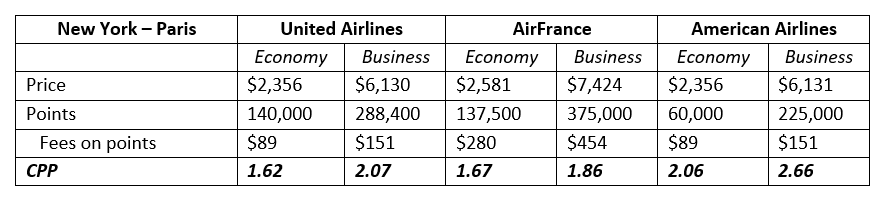
As we say from the table above, American Airlines offers the best CPP for this flight category for the same dates. Now personally, I would consider paying by points on American since its redemption value (CPP) > 2. Generally, 60K points for a $2K ticket seems like a good deal to take – and this especially comes into handy if one were to opt for an airline credit card which provides introductory offers. However, one major nuance here is that these CPP depend on dynamic ticket pricing, which in-turn is based on ticket availability. In essence, if I were to run the same analysis on these flight dates and times on a different day, there are very high chances that the CPP would be different.
To summarize, loyalty points can be great if used wisely – and they are great for the airlines and for the customers. Although, one must choose their preferred airline carefully to be able to earn points and build status. Loyalty programs require significant research and planning to be able to maximize the value generation.
* some airlines have started offering a subscription model for greater benefits but have also retained the free program. For example, Emirates is now offering a three-tiered Skywards+ subscription program which gives you access to additional discounts and extra baggage allowances. Basic Skywards membership is still free though.
Disclaimer: This blog is a collection of the authors thoughts on the subject. It is not meant to provide the reader any financial advice, or advice on how to use the points. No paid promotions were cited in this article.
Sources: The Points Guy, Nerdwallet, Mapquest, Airlinegeeks, CNBC news, Travel-on-points